
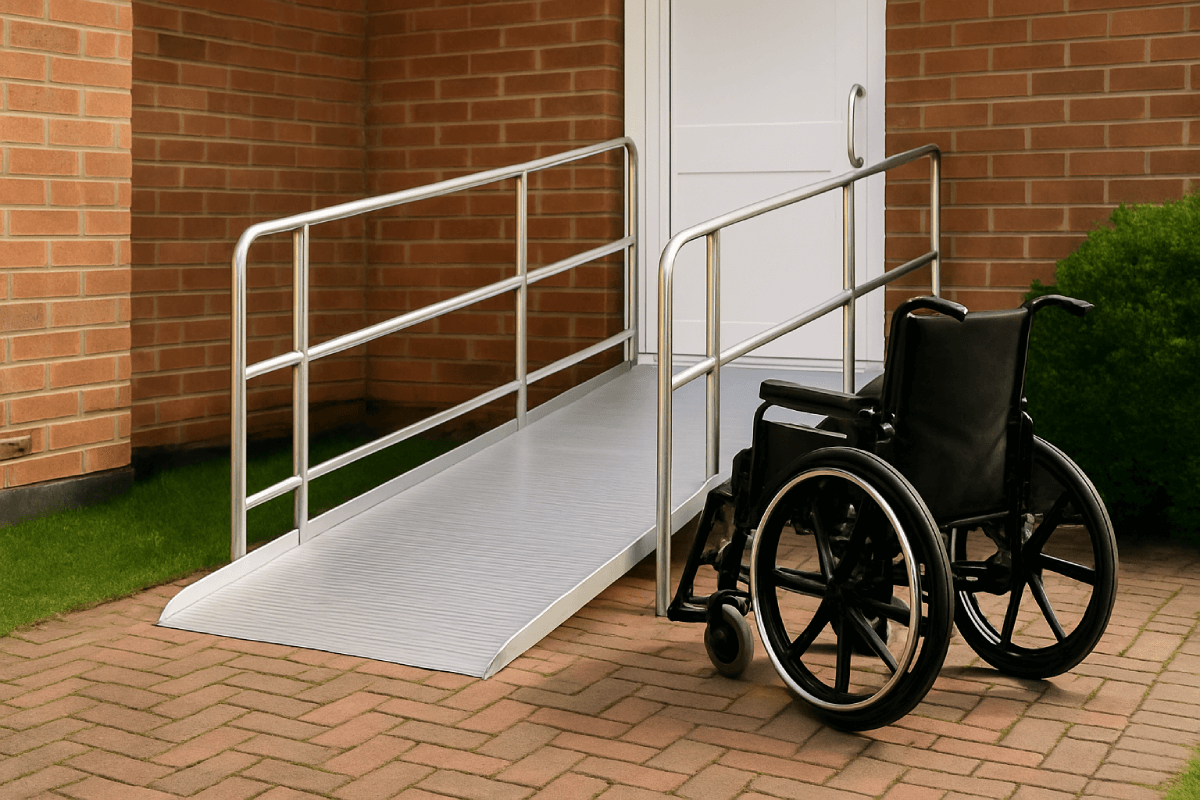
Not every fall risk starts with a full staircase. In many homes, the most frustrating and dangerous barriers are much smaller: a raised doorway threshold, a short step down into the garage, an uneven patio edge, or a transition that keeps catching wheels and toes. These are the kinds of spots people walk over every day without thinking about them until they become painful, risky, or impossible to ignore.
The good news is that small access problems often have practical solutions. The right ramp can smooth out movement, reduce trip hazards, and make daily routines easier for wheelchair users, scooter users, walkers, and caregivers. This guide explains when a small ramp is enough, how to compare ramp types, and when it is time to step up to a larger access solution.
Why small height changes cause bigger problems than people expect
A one-inch or two-inch rise may not sound serious, but those little transitions can create a lot of instability. They interrupt wheel movement, force awkward body mechanics, and increase the chance of catching a foot, walker leg, or caster at the worst possible moment.
- Door thresholds can stop a wheelchair or scooter suddenly.
- Garage steps often create a risky daily entry point.
- Sliding-door tracks can trip people who already have balance concerns.
- Patio edges and small exterior rises become harder when fatigue, pain, or poor footing are involved.
That is why small ramps often have an outsized effect. They do not just make access smoother. They reduce stress, hesitation, and the constant need to “work around” the same trouble spot every day.
When a threshold ramp is usually the right answer
Threshold ramps are often the fastest and simplest fix when the issue is a doorway lip, sliding-door track, short rise, or another compact transition. They help create a smoother roll for wheelchairs, walkers, scooters, and transport chairs without turning a minor access issue into a major renovation.
ZMI’s rubber threshold ramp line is a good example of where this works well. These ramps are built for safer door transitions, install quickly, and are designed to improve traction while reducing the abrupt bump that catches wheels. They are especially useful when the change in height is modest and the goal is immediate everyday safety.
A threshold ramp is often a strong fit when:
- the rise is small and localized
- you need a clean fix at a doorway or track
- you want a fast improvement without major construction
- the user mainly needs smoother rolling access, not a long approach ramp
When a portable ramp makes more sense
Sometimes the problem is not a fixed doorway but a short set of steps, a vehicle transition, or a location where access needs change throughout the day. In those cases, a portable solution may be more practical than a permanent ramp.
Multi-Fold Ramps are useful because they fold for transport and storage while still offering meaningful support for everyday movement. They can be a strong option when a family wants flexibility, when access needs happen in more than one location, or when the ramp must travel with the user.
Portable ramps make sense when:
- the access point changes regularly
- the ramp needs to work at home and on the go
- you want something easier to store between uses
- the obstacle is short-term or semi-temporary
They are convenient, but they still need the right fit. A portable ramp that is too short, too steep, or too narrow can create its own problems.
When it is time to move up to a modular ramp system
Some homes need more than a quick threshold fix. If the entry has multiple steps, a longer rise, or a daily-use approach that needs handrails and stable footing, a modular system is often the safer long-term answer.
Aluminum Modular Ramps are designed for that next level of need. ZMI’s modular ramp solutions can be custom-fit for homes or businesses, use non-slip surfaces and continuous handrails, and work well when a family needs dependable day-in, day-out access instead of a short transition fix.
A modular ramp is usually the better fit when:
- the rise is too tall for a simple threshold ramp
- the user needs a stable, consistent main entrance route
- the approach requires handrails, turns, or landing space
- the home is being adapted for longer-term accessibility
If you already know the access problem is bigger than one doorway, the broader Mobility Ramps category and Ramp Access Solutions page are both useful next stops.
How to measure before you buy
Good ramp recommendations start with accurate measurements. Even a strong product can feel unstable or awkward if the rise, length, or available landing area was guessed instead of measured.
- Measure the vertical rise: Start from the lower surface and measure straight up to the top of the obstacle.
- Check the available run: Make sure there is enough room for the ramp to sit properly without blocking doors or walkways.
- Consider the device: A walker, manual wheelchair, power chair, and scooter all interact with ramps differently.
- Think about turning and approach space: The area before and after the ramp matters almost as much as the ramp itself.
For longer ramp runs, slope matters more. The official U.S. Access Board ramp guidance is a helpful reference when you are thinking beyond a simple doorway transition and into a larger ramp layout.
Common mistakes people make with small ramps
Most ramp problems are not caused by buying a “bad” ramp. They happen because the ramp type does not match the obstacle or the user.
- Choosing a ramp based only on price instead of fit.
- Using a ramp that is too short, which creates a steeper approach than expected.
- Ignoring how a scooter or power chair actually turns and lands.
- Forgetting to account for wet areas, outdoor exposure, or surface traction.
- Trying to make one tiny ramp solve a larger entry problem that needs a modular system instead.
The right ramp should make movement feel simpler and calmer. If the setup still feels awkward, unstable, or frustrating, it may be the wrong category of solution rather than the wrong user.
Best places to use small ramps around the home
People often think of ramps only at the front door, but some of the most useful improvements happen inside the normal flow of the home.
- Front entries: Reduce the jolt and hesitation of threshold crossings.
- Garage access: Smooth out the common step between house and garage.
- Patio and backyard doors: Make outdoor access more realistic and less tiring.
- Sliding doors: Help walkers, wheelchairs, and scooters clear raised tracks safely.
- Interior transitions: Bridge small surface changes that catch wheels or create toe-stub hazards.
These small fixes are especially valuable when the goal is to support aging in place without overbuilding the solution.
How ZMI Mobility helps match the ramp to the real problem
One of the biggest mistakes in accessibility planning is jumping straight to a product without clarifying the obstacle. ZMI Mobility can help sort through whether the issue is really a threshold problem, a portable access problem, or a larger entry redesign.
That matters because the right answer may be as simple as a threshold ramp, or it may be a modular ramp system with a more complete plan for safer entry. Either way, matching the solution to the user, the space, and the device saves time and prevents frustration.
Small fixes can change everyday confidence fast
Accessibility improvements do not always need to start with a major construction project. In many homes, the first meaningful win is simply removing the daily friction at a doorway, track, or short rise that has been causing trouble for months.
If you are not sure where to start, compare the products in Mobility Ramps, review the broader Ramp Access Solutions service page, and reach out through Contact Us. A small ramp may be the quickest path to safer, smoother movement at home.