
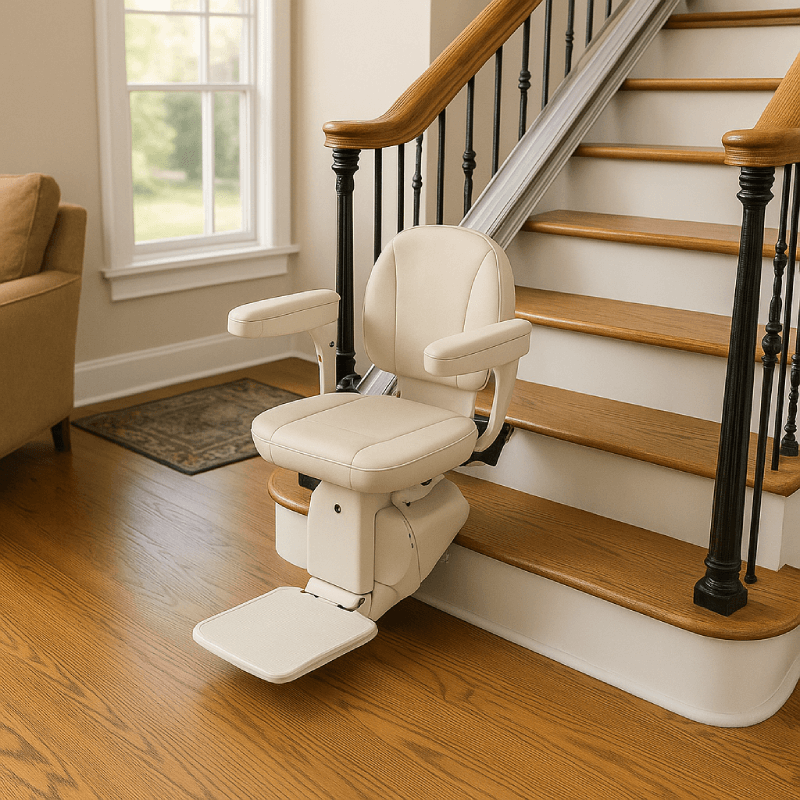
Stair access solutions often become urgent long before a family is ready to admit it. At first, the stairs just feel slower. Then someone starts carrying laundry one step at a time, avoiding the upstairs shower, or pausing halfway to rest and gather confidence. Eventually the staircase begins to control the routine of the house.
That is why the right solution can feel life-changing. When stair access becomes safe and simple again, people do not just move more easily between floors. They regain comfort, privacy, energy, and the freedom to use their home normally. This guide explains how that shift happens, what options to compare, and how to tell whether a straight stair lift, curved stair lift, or vertical platform lift is the best next step.
The moment stairs stop feeling simple
For many households, the problem does not begin with a dramatic fall. It begins with repeated hesitation. Someone starts gripping the rail harder. A caregiver begins shadowing every trip up and down. The upstairs bedroom becomes stressful instead of restful. These are often the first signs that the stairs are no longer just part of the house. They are becoming a daily obstacle.
- Trips up and down the stairs take noticeably longer.
- Fatigue makes a once-normal staircase feel intimidating.
- One level of the home starts getting used less and less.
- Near falls, toe catches, or painful transfers become more common.
- Family members begin planning the day around who can help on the stairs.
When that pattern shows up, it is usually time to look at real stair access solutions instead of hoping the problem stays manageable.
How one home solution changes daily life
What families often want most is not a dramatic “mobility upgrade.” They want the ordinary parts of home to feel ordinary again. That can mean sleeping in the right bedroom, using the bathroom without planning for help, or getting downstairs in the morning without a rush of anxiety.
A well-matched lift can change all of that quickly. Once the system fits the staircase and the user correctly, the emotional shift is often just as important as the physical one. People stop conserving energy for the stairs. Caregivers stop bracing for every transfer. The house feels usable again.
That is why this conversation should be about quality of life, not just hardware. The best result is not “a lift was installed.” It is “the home started working again.”
Signs it is time to explore stair access solutions
Families often wait longer than they should because the person using the stairs is still technically able to manage them. But “still managing” and “moving safely and confidently” are not the same thing.
You should start comparing options when:
- stairs are causing pain, fatigue, or loss of confidence
- one floor of the home is being avoided
- a caregiver is needed just to supervise movement between levels
- balance changes, surgery recovery, or progressive mobility issues are making each trip riskier
- a wheelchair or power chair is part of the long-term plan and stairs are becoming a hard stop
It is often easier to choose calmly before there is a crisis than to rush a decision after a fall or medical setback.
Straight stair lift, curved stair lift, or vertical platform lift?
Most home stair access decisions come down to three main categories:
Straight stair lifts
A straight stair lift is usually the simplest option when the staircase runs in one continuous line without turns or intermediate landings. These systems are often the fastest to specify and install, which makes them a strong fit for many everyday homes.
Curved stair lifts
If the staircase has bends, landings, or shape changes, a curved stair lift is often the better answer. These systems are built to follow the exact path of the stairway, which is why precise measurement and custom fit matter so much.
Vertical platform lifts
A vertical platform lift can be the right option when the user needs to stay in a wheelchair or power chair rather than transfer to a stair-lift seat. They are also valuable for porches, split-level entries, and low-rise vertical access problems where a seated stair lift is not ideal.
If you are browsing categories first, start with Stair Lifts for seated lift options and Vertical Platform Lifts for wheelchair-friendly vertical access.
When a stair lift is the best fit
Stair lifts are often the right answer when the user can transfer safely onto a seat and the goal is comfortable movement up and down an interior or exterior staircase.
For example, the Bruno Elan Straight Rail Stairlift is a clean, budget-conscious option for straight stairs, with soft starts and stops and a compact design that works well in many homes. For more complex stairs, the Harmar Helix Curved Stairlift is built to follow curved staircases with a more tailored rail path.
A stair lift is often a strong fit when:
- the user can transfer to a seat safely
- the main challenge is navigating a staircase rather than standing on a platform with a mobility device
- the family wants a compact in-home solution
- comfort, simplicity, and quick routine use matter most
When a vertical platform lift may be the better solution
A stair lift is not always the right choice, especially when a transfer is difficult or unsafe. In those cases, a vertical platform lift can offer a more stable path because the user remains in a wheelchair or power chair during travel.
The Savaria Multilift Vertical Platform Lift is a good example of where this becomes valuable. It is designed for low-rise settings like decks and porches and can support users with or without wheelchairs or power chairs. That makes it useful when the access issue is not just “stairs” in the traditional sense, but the broader challenge of getting between levels without a risky transfer.
A vertical platform lift may be the better fit when:
- the user needs to remain in a wheelchair or power chair
- transferring onto a stair-lift seat is not realistic
- the access challenge involves a porch, deck, or split-level rise
- a household wants a solution that can serve a wider range of mobility needs over time
What a home assessment should cover
The best stair access outcomes start with a good assessment. The staircase shape matters, but so do the user’s mobility, transfer ability, hand strength, balance, and long-term goals.
A proper assessment should look at:
- straight versus curved stair layout
- landing space at the top and bottom
- seat transfer ability and comfort
- whether a wheelchair or power chair needs to stay in use
- indoor versus outdoor conditions
- how the solution will fit into the family’s normal daily routine
For broader technical context on accessible routes and level changes, the U.S. Access Board accessibility guidance is a helpful reference. In practice, though, the right home recommendation still depends on how the person actually moves through the space every day.
What installation and everyday use should feel like
The right system should make the home feel calmer, not more complicated. After installation, daily use should feel predictable and low-stress. Controls should be easy to understand. Boarding and unloading should feel stable. The user should not need to “figure it out again” every time they use it.
This is also where support matters. A stair access solution becomes part of the rhythm of home life, so fit, training, and ongoing reliability are just as important as the product choice itself.
If outdoor stairs are part of the problem too, the guide on Outdoor Stair Lifts is a good companion read.
How ZMI Mobility helps families choose with confidence
ZMI Mobility’s role is not just to install equipment. It is to help match the right kind of access solution to the home, the staircase, and the person using it. Sometimes that means a straightforward seated stair lift. Sometimes it means a curved rail system. Sometimes the better answer is a vertical platform lift because the user should stay in their chair.
The goal is simple: make sure the solution supports daily living instead of creating a new set of compromises. If you are ready to compare options, start with Stair Access Solutions and then reach out through Contact Us for a more personalized recommendation.